Most charity strategies look fine on paper. Then daily decisions don’t follow them.
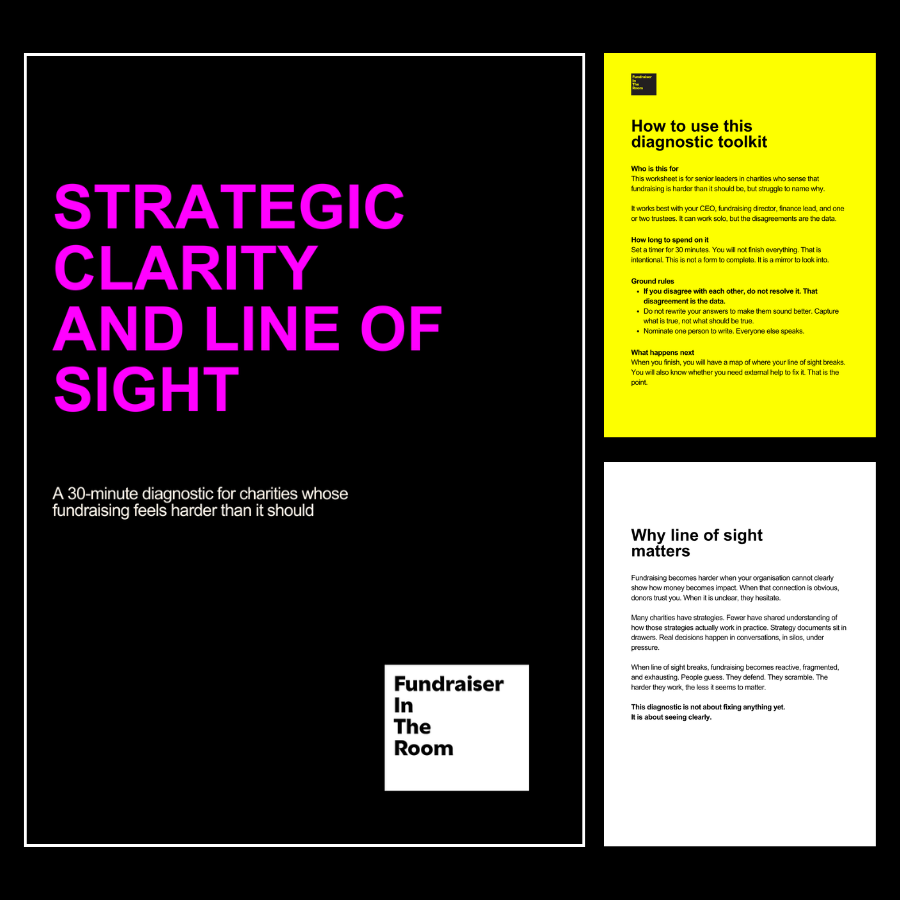
This is a 30-minute self-diagnostic for charity leaders who sense their fundraising could be working harder than it is. It will not fix your fundraising. It will tell you, honestly, whether your line of sight is clear, and where it breaks.
What is it?
This is not a guide. It is not a framework. It is a worksheet.
Twelve pages of structured questions designed to surface, in plain language, whether the people in your organisation can trace a clear line from mission, to outcomes, to the income that funds them, to the daily work your fundraisers are doing this week.
Most charities cannot. They run the strategy, and they run the fundraising, but the connection between the two is decorative rather than working. Donors notice it. Fundraisers feel it. Boards struggle to explain it. Income shows the strain.
This worksheet does not solve that. It makes it visible.
Who is it for?
We wrote this for:
- CEOs and Executive Directors who have a strategy that is supposed to be working, and want to test whether it actually translates into fundraising decisions.
- Fundraising Directors and Heads of Income who can feel the gap between the plan and the practice but have not had language for it.
- Trustees who are about to enter a budget cycle and want better questions to take into the boardroom.
- Senior fundraising managers who suspect the system around their team is the limiting factor, not the team itself.
If you are looking for tactics, channel advice, or a fundraising playbook, this is not the right resource. We will point you to people who do that work brilliantly. This worksheet is upstream of all of it.
What will I get?
- A 12-page A4 PDF, designed to be printed or filled in on screen.
- 30 minutes of structured questioning across three sections: mission to outcomes, outcomes to income, strategy to daily work.
- A one-page Line of Sight Map exercise that surfaces, visually, where your chain breaks.
- A reality check page that tells you, honestly, whether you have a focused problem or a structural one.
It’s free. There is no upsell at the end.
What will it ask of me?
It is deliberately uncomfortable. Some of the questions are hard to answer cleanly. That is the point.
If you breeze through every page, the worksheet is not doing its job. The questions you stall on are the most useful ones. We say this in the introduction, and we mean it.
It works best when two or three senior colleagues complete it independently and compare answers. Disagreement reveals the system. Agreement on a thing that no one had spelled out reveals it more.
Get the Line of Sight Worksheet